Mastering Cost Realism Analysis in Federal Contracting
Cost realism analysis is more than a pricing checkpoint. It’s a compliance gate, a performance predictor, and a silent deal-breaker. Under FAR 15.404-1(d), federal agencies use cost realism to assess whether proposed costs reflect the actual effort required.
Cost Realism vs Price Reasonableness, Know the Difference
Many contractors confuse cost realism with price reasonableness. They’re not the same.
- Price reasonableness checks if a price is fair compared to market rates.
- Cost realism evaluates whether the cost is sufficient to deliver the work.
Agencies apply realism analysis to ensure the offeror can perform without cutting corners or seeking future modifications.
The Strategic Impact of Cost Realism on Proposal Success
Cost realism affects more than compliance. It shapes:
- Bid competitiveness
- Indirect rate strategy
- Audit defensibility
- Task order pricing flexibility
A well-structured cost proposal signals operational maturity. It shows the contractor understands both the technical scope and the financial realities of federal performance.
What This Blog Will Cover
This guide will explore:
- How cost realism analysis works under FAR
- The role of indirect rates in shaping realism
- Common pitfalls and protest risks
- Strategies for pricing to win — and perform
Understanding Organizational Conflicts of Interest (OCI): The Three Types
What Is an Organizational Conflict of Interest (OCI)?
An OCI occurs when a contractor’s role, relationships, or access to information could compromise fairness or objectivity in federal contracting.
Under FAR Subpart 9.5, agencies must identify and mitigate OCI risks to protect the integrity of the procurement process.
Contractors must proactively assess and disclose potential conflicts — or risk disqualification, protest, or reputational damage.
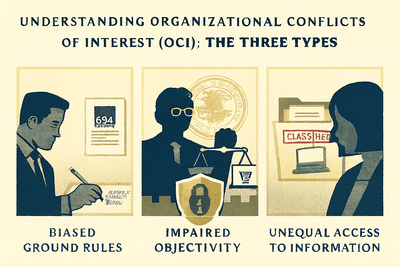
The Three Types of OCI in Federal Contracting
Federal agencies recognize three primary types of OCI. Each presents unique risks and requires tailored mitigation strategies.
1. Biased Ground Rules OCI
Definition: Occurs when a contractor helps draft specifications, statements of work, or evaluation criteria — and then bids on the resulting contract.
Risk: The contractor may shape requirements to favor its own capabilities.
Example: A firm that writes a performance work statement (PWS) for a cybersecurity contract later submits a proposal to perform that work.
Mitigation Tactics:
- Exclude the contractor from follow-on work
- Use third-party reviewers
- Document role separation
2. Impaired Objectivity OCI
Definition: Arises when a contractor is tasked with evaluating products, services, or performance — including those of its own affiliates or competitors.
Risk: The contractor may struggle to remain impartial.
Example: A contractor hired to assess software solutions also sells a competing product.
Mitigation Tactics:
- Assign independent evaluators
- Implement internal firewalls
- Disclose financial interests
3. Unequal Access to Information OCI
Definition: Occurs when a contractor gains access to non-public information that could give it an unfair competitive advantage.
Risk: The contractor may use sensitive data to shape its proposal or strategy.
Example: A support contractor working inside an agency gains early access to acquisition plans or budget forecasts.
Mitigation Tactics:
- Restrict access to sensitive data
- Enforce NDAs and data handling protocols
- Rotate personnel to avoid overlap
Why Understanding OCI Types Is Crucial
Each OCI type requires a different mitigation approach. Agencies expect contractors to:
- Identify risks early
- Disclose potential conflicts
- Propose credible mitigation plans
Failure to do so can lead to GAO protests or contract termination.
When and Why Organizational Conflicts of Interest (OCI) Are Triggered
OCI Risk Isn’t Rare, It’s Embedded in Federal Work
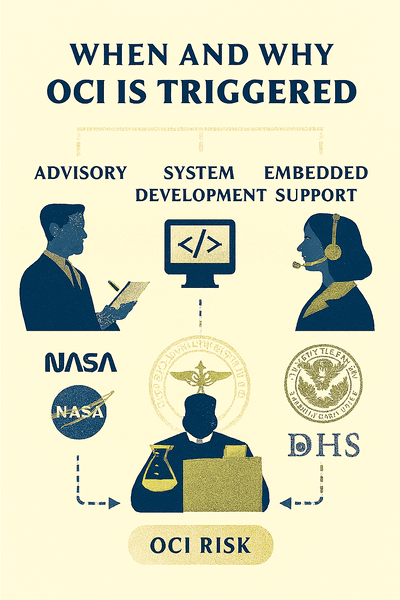
Organizational conflicts of interest (OCI) often arise not from misconduct, but from contractor positioning. The more embedded a firm is in agency operations, the higher the risk.
Agencies are required under FAR Subpart 9.5 to identify and mitigate OCI before awarding contracts. Contractors must understand when OCI is likely.
Common Scenarios That Trigger OCI in Federal Contracting
These situations frequently raise OCI flags during proposal reviews and pre-award evaluations:
1. Advisory and Assistance Services
Why it triggers OCI: Contractors advising on acquisition strategy, technical evaluations, or policy development may later bid on related work.
Example: A firm that helps draft a solicitation later proposes to perform the work.
Risk Type: Biased ground rules OCI
2. System Development and Integration
Why does it triggers OCI: Developing or integrating systems gives contractors deep technical insight — and potential influence over future procurements.
Example: A contractor builds a data platform, then bids to operate or assess it.
Risk Type: Impaired objectivity or unequal access OCI
3. Program Management and Oversight Roles
Why it triggers OCI: Managing or evaluating other contractors creates objectivity concerns.
Example: A firm overseeing subcontractor performance also competes for similar work.
Risk Type: Impaired objectivity OCI
4. Embedded Support Contractors
Why it triggers OCI: Contractors working onsite or within agency systems may access non-public data.
Example: A support contractor sees budget forecasts or acquisition plans before release.
Risk Type: Unequal access to information OCI
5. Recompetes and Follow-On Contracts
Why it triggers OCI: Incumbents often hold institutional knowledge that can tilt the playing field.
Example: A contractor rebidding on a program it previously staffed or scoped.
Risk Type: All three OCI types, depending on context
Why Agencies Are Increasingly Scrutinizing OCI
Recent bid protests show that even perceived conflicts can derail awards. Contractors must:
- Disclose potential OCI early
- Propose credible mitigation plans
- Avoid roles that compromise future eligibility
Crafting an Effective OCI Mitigation Plan
Why an OCI Mitigation Plan Is Essential
A strong OCI mitigation plan isn’t optional, it’s a proposal survival tool. Agencies expect contractors to identify, disclose, and neutralize potential conflicts before award.
Under FAR Subpart 9.5, mitigation plans must be credible, specific, and enforceable. Vague language or recycled templates won’t pass scrutiny.
Key Components of an Effective OCI Mitigation Plan
Each mitigation plan should be tailored to the type of OCI and the contractor’s role. Here’s what to include:
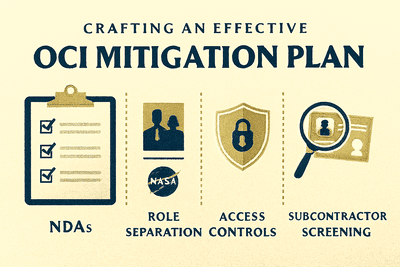
1. Role Separation and Firewalls
Purpose: Prevent overlap between conflicting functions.
Tactics:
- Assign separate teams for advisory vs execution roles
- Physically and digitally isolate workstreams
- Use access-controlled systems
Example: A contractor supporting acquisition planning is barred from bidding on the resulting contract.
2. Non-Disclosure Agreements (NDAs)
Purpose: Limit the spread of sensitive information.
Tactics:
- Require NDAs for all personnel with access to non-public data
- Include subcontractors and consultants
- Track NDA compliance
Example: Support staff with insider budget access sign NDAs and are excluded from proposal teams.
3. Information Access Controls
Purpose: Prevent unfair competitive advantage.
Tactics:
- Restrict access to procurement-sensitive data
- Use secure, segmented systems
- Monitor and log data access
Example: A contractor’s internal firewall blocks proposal teams from viewing client-side documents.
4. Personnel Rotation and Screening
Purpose: Avoid continuity-based conflicts.
Tactics:
- Rotate staff between contracts to prevent overlap
- Screen new hires for OCI exposure
- Document personnel assignments
Example: A program manager from a prior contract is reassigned to a non-conflicting role.
5. Subcontractor and Partner Vetting
Purpose: Ensure teaming partners don’t introduce OCI risk.
Tactics:
- Require OCI disclosures in teaming agreements
- Review partner past performance and roles
- Apply mitigation protocols across the team
Example: A subcontractor with prior advisory roles is excluded from technical proposal development.
How to Present Your Mitigation Plan in Proposals
Agencies want clarity, not boilerplate. Your plan should:
- Reference specific contract sections and risks
- Use plain language and structured formatting
- Include diagrams or tables if helpful
What Happens If You Don’t Mitigate OCI
Failure to submit a credible plan can lead to:
- Proposal rejection
- GAO protest (see GAO Bid Protest Database)
- Contract termination
- Long-term reputational damage
Agencies are increasingly risk-averse. They’d rather disqualify than defend.
OCI Protest Case Studies: Lessons from GAO
Why OCI Protests Matter in Federal Contracting
Organizational Conflict of Interest (OCI) protests are among the most disruptive and revealing events in federal procurement. They expose how agencies interpret FAR Subpart 9.5 – and how contractors succeed or fail in defending their mitigation strategies.
The Government Accountability Office (GAO) publishes detailed decisions that shape OCI precedent. Studying these cases helps contractors avoid costly mistakes and build stronger proposals.
Common Themes in GAO OCI Protest Decisions
1. Vague Mitigation Plans Lead to Rejection
Case Example: McCarthy/Hunt JV, B-420626.2 (2022)
Issue: The contractor submitted a generic OCI mitigation plan without addressing specific risks tied to its prior advisory role.
GAO Ruling: The agency failed to reasonably assess the conflict. Protest sustained.
Lesson: Mitigation plans must be tailored, detailed, and directly responsive to the identified OCI.
2. Incumbent Advantage Can Be a Liability
Case Example: Health Net Federal Services, B-401652 (2009)
Issue: The incumbent had access to sensitive data and was awarded a follow-on contract.
GAO Ruling: Unequal access to information created an OCI. Protest sustained.
Lesson: Even incumbents must demonstrate how insider knowledge won’t skew competition.
3. Subcontractor History Can Sink the Prime
Case Example: SRA International, B-406061 (2012)
Issue: A subcontractor previously helped develop the solicitation.
GAO Ruling: Biased ground rules OCI was not adequately mitigated. Protest sustained.
Lesson: Prime contractors are responsible for vetting and mitigating partner OCI risks.
4. Agencies Must Document Their OCI Analysis
Case Example: Northrop Grumman Systems Corp., B-406027 (2012)
Issue: The agency failed to document its OCI review and rationale.
GAO Ruling: Lack of documentation invalidated the award decision. Protest sustained.
Lesson: Agencies must show a reasoned OCI analysis — and contractors should prompt it if missing.
How to Use GAO Case Law to Strengthen Your Proposal
Before submitting your bid:
- Search the GAO Bid Protest Database for similar contract types
- Review OCI protest outcomes by agency and function
- Cite relevant cases in your mitigation plan to show awareness and credibility
Final Takeaway
OCI protests are preventable. Contractors who study past failures build stronger defenses.
Mitigate to Compete, Compete to Win
Organizational Conflict of Interest (OCI) isn’t just a compliance checkbox.
Contractors who understand the nuances of FAR Subpart 9.5, proactively vet their teams, and craft tailored mitigation plans don’t just avoid protests.
Takeaways for Federal Contractors
- Know the three OCI types – biased ground rules, impaired objectivity, and unequal access.
- Identify triggers early – especially in advisory, oversight, and embedded roles.
- Craft credible mitigation plans – with role separation, NDAs, and access controls.
- Vet your partners – OCI is a shared liability across teams.
Study GAO case law – learn from past protests to future-proof your proposals.