
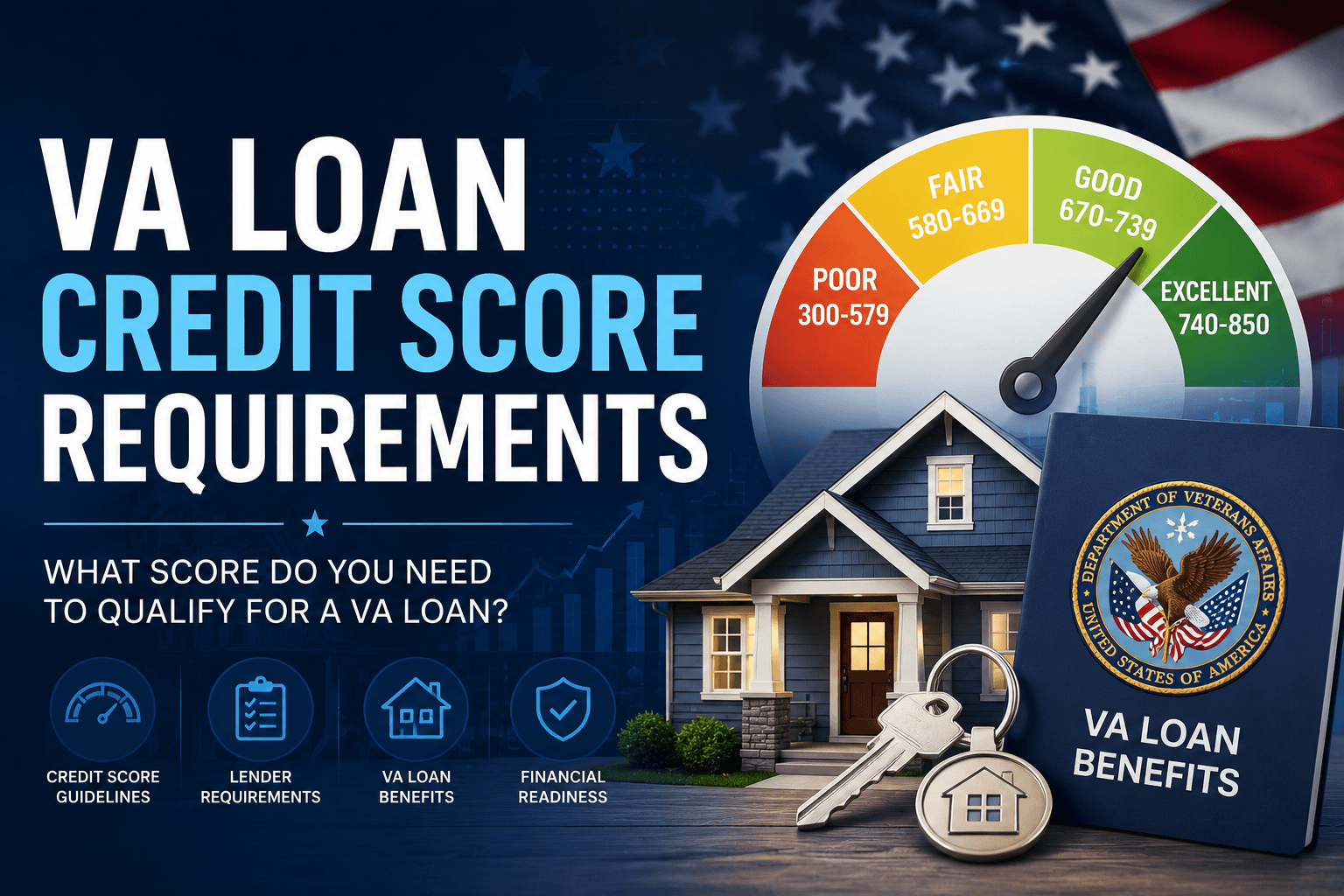
If you are looking for homeownership, then VA loans can make it much more accessible for you than you think.
VA loans have proven to be better than traditional mortgage options for many veterans, active-duty service members, and eligible spouses as they are free of no down payment and minimal interest rates.
Despite the flexibility of VA loans, most of the borrowers are still not free from the worry of VA Loan Credit Score Requirements. However, you can feel relieved after knowing that you do not need perfect credit for VA home loan qualification.
Being aware of credit scores can help you to prepare better for the VA loan process and increase your loan approval chances.
In this article, you will learn about minimum credit score requirements, their ranges and the common myths people have regarding the scores.
What is the Minimum Credit Score Requirement for a VA Loan?
The Department of Veterans Affairs does not set a minimum credit score requirement and this makes VA loans one of the most flexible programs.
However, this does not mean that credit scores are not important at all.
While the other types of mortgages usually focus on a number, the VA wants to ensure whether a borrower has the ability to repay the loan rather than concentrating on a specific cutoff. This tells you that your overall financial situation is more essential rather than a certain credit score. Lenders primarily consider factors such as payment history, income stability, debt levels.
So, you can still qualify for the loan with a low credit score if all the other criteria are met. In cases of no credit score, lenders can use non-traditional credit, for example, rent, utility payments.
Lenders significantly consider your debt-to-income (DTI) ratio,which is usually limited, and your “residual income”, the revenue left over for living expenses.
But, it is also crucial to understand that though the VA does not specify a minimum score, lenders often do so. Usually, mortgage lenders set their own credit score requirements.
This lessens the risk quotient and is often known as “lender overlays”.
VA Loan Credit Score Ranges
Even though the VA does not set a minimum credit, lenders can demand otherwise.
Lenders have the ability to evaluate borrowers in credit score bands. This can directly affect your approval chances, underwriting type, and loan pricing. As lenders typically issue the loans, their requirements will determine whether your application will be approved or not. They can control the funding decision through credit overlays.
So, you can say that your credit score is still an important factor in how easily you qualify. Your Certificate of Eligibility (COE) guarantees that you can use the VA loan benefit. However, your lender’s credit overlay determines whether they will approve and grant your loan at your credit score.
These overlays mostly vary, therefore your credit facilities can make your chances better, especially when you are closer to a cut off. Note that a stronger credit profile is required for a high loan amount, for instance above $1 million even when basic criteria is met.
The best way to estimate how lenders will evaluate your application and what are your approval chances is to keep accurate knowledge about these ranges.
Score ranges are usually grouped based on underwriting depth and loan pricing.
Credit Score Band: 740+
Borrowers in this range are in the best position. These profiles are considered as very low risk and ensure nearly positive results.
- Quick approvals
- Smoother processing
- Minimum documentation required
- Lowest interest rates
- Higher chances of automated underwriting approval
Credit Score Band: 680-739
This is a strong approval range and the borrowers are usually considered financially stable.
- The approval chances are high among lenders
- Interest rates are comparatively high
- Underwriting process is typically smooth
- Pricing adjustments are minor, most 0.25% or less
Credit Score Band: 620-679
This is the standard approval range. This range is usually the most common and aligns with the 620 lender overlay.
This range does not ensure approval, but gives a good chance with increased scrutiny
- Minimal requirement of most lenders is met
- Might get Approve/Eligible or Refer findings in AUS
- Extra documentation may be required
- Entire financial profile is assessed, for example, DTI, income, reserves
Credit Score Band: Below 620
This is the manual underwriting zone.
The process becomes more complicated if it goes below 620.
- Automated underwriting does not work and often returns “Refer”
- Manual underwriting often becomes mandatory
- Significant compensating factors are required, for example, a clear 12-month payment history, regular income, liquid assets and significant passive income.
For instance: If a borrower has a low score but a clear recent history, their loan might get approved before the one who has a higher score but is late to payments.
Credit Score Band: 550-600
This range does not mean your loan approval is not impossible, but considerably lowers your chances.
Several lenders work for this segment actively:
- Freedom Mortgage may approve score around 550
- Guild Mortgage and Fairway Independent may serve borrowers with 580+
- Strong documentation needed, for example, steady employment, proven income and financial savings
- Manual underwriting is expected almost every time.
Credit Score Band: 500-549
This is the niche lending segment where loan approval is not impossible but rare.
In this range, specialized lenders and brokers work with the borrowers.
- Lenders such as Carrington Mortgage might go as low as 500
- Significant compensating components are obligatory
- Stricter conditions
- Deeper review of underwriting
Lender Requirements of VA Loan Credit Score 2026
Credit requirements differ depending on the lenders.
These requirements determine that approval strongly relies on lender selection and a universal VA credit requirement does not exist.
| Name of Lenders | Minimum Credit Score |
| Veterans United Home Loans | 620 |
| Navy Federal Credit Union | 620 |
| DHI Mortgage | 620 |
| Rocket Mortgage | 620 |
| USAA | 640 |
| Fairway Independent Mortgage | 580+ |
Note that this information is changeable and not fixed publicly.
But, we can conclude that several lenders generally prefer scores around 580–640, relying on underwriting and compensating elements.
Real Information of VA Loan (FY 2024)
These data show that borrowers from all credit ranges have achieved VA loans approvals. This also proves that VA loans do not only belong to high-credit borrowers.
| Credit Range | Percentage |
| 720+ | 57.5% |
| 680-719 | 16.6% |
| 640-679 | 15.0% |
| 620-639 | 6.2% |
| Below 620 | 4.8% |
Conclusion
VA loans strive to offer both accessibility and flexibility while providing home financing options when compared to other mortgage programs.
On the brighter side, you will still have a strong chance of loan acceptance even with a low credit score. You just need to keep the correct knowledge and follow the necessary rules and regulations.
You may be eligible for the loan requirements sooner than you might think. Hence, it is recommended to research your options before assuming that you might not qualify for a VA loan.
Frequently Asked Questions About VA Loan Credit Score Requirements
What does the 4% rule on a VA loan mean?
The 4% rule lets the seller pay up to 4% of the home’s purchase price toward the buyer’s extra costs. These extra costs include things like paying off the buyer’s existing debts, prepaid property taxes, and homeowner’s insurance. The seller also covers the standard closing costs separately, on top of that 4% limit. So in many cases, the seller’s total contribution exceeds 4% when you count both together. If you want help calculating what a seller can cover in your specific purchase, speak with a VA loan specialist.
Is it difficult to assume a VA loan?
The qualification side is usually straightforward, but the timeline makes the process challenging. Most VA loan assumptions take 60 to 90 days or longer to complete. The lender must review and approve the new borrower’s credit score and income before the transfer goes through. Missing documents or lender delays stretch that timeline even further. Plan well ahead if you want to assume a VA loan so the process does not slow down your purchase.
Can a non-veteran assume a VA loan?
Yes, a non-veteran can assume a VA loan. The new borrower keeps the same interest rate and loan terms as the original veteran borrower. However, the new borrower must still qualify with the lender by meeting their credit and income requirements. The lender also charges a VA funding fee of 0.5% of the remaining loan balance to process the assumption. One important note: when a non-veteran assumes the loan, the original veteran’s VA entitlement stays tied up until the buyer pays off that loan in full.
What are the current VA loan interest rates?
VA loan rates change every single day. Each lender sets its own rate based on your credit score, loan amount, loan type, and current market conditions. The only way to find your actual rate is to request quotes from at least three VA-approved lenders on the same day and compare them directly. Even a small rate difference adds up to thousands of dollars over the life of a 30-year loan. A VA loan specialist can help you compare lenders quickly and find the most competitive rate for your situation.
How do I know if I qualify for a VA loan?
You qualify for a VA loan if you meet at least one of these service requirements: 90 days of active duty during wartime, 181 days of active duty during peacetime, or 6 years of service in the National Guard or Reserves. After confirming your service record, you request a Certificate of Eligibility from the VA. That certificate proves to lenders that you have earned your VA loan benefit. If you are unsure which service category applies to you, a VA loan specialist can pull your COE and walk you through your eligibility in minutes.
What is the highest VA loan limit?
There is no loan limit for eligible veterans with full VA entitlement in 2026. You can borrow as much as a lender will approve without any cap set by the VA. Loan limits only apply if you have reduced entitlement from a prior VA loan you have not fully paid off or sold. In that case, county-level conforming loan limits determine how much you can borrow without a down payment. A VA loan specialist can check your current entitlement status and tell you exactly how much you can borrow.