
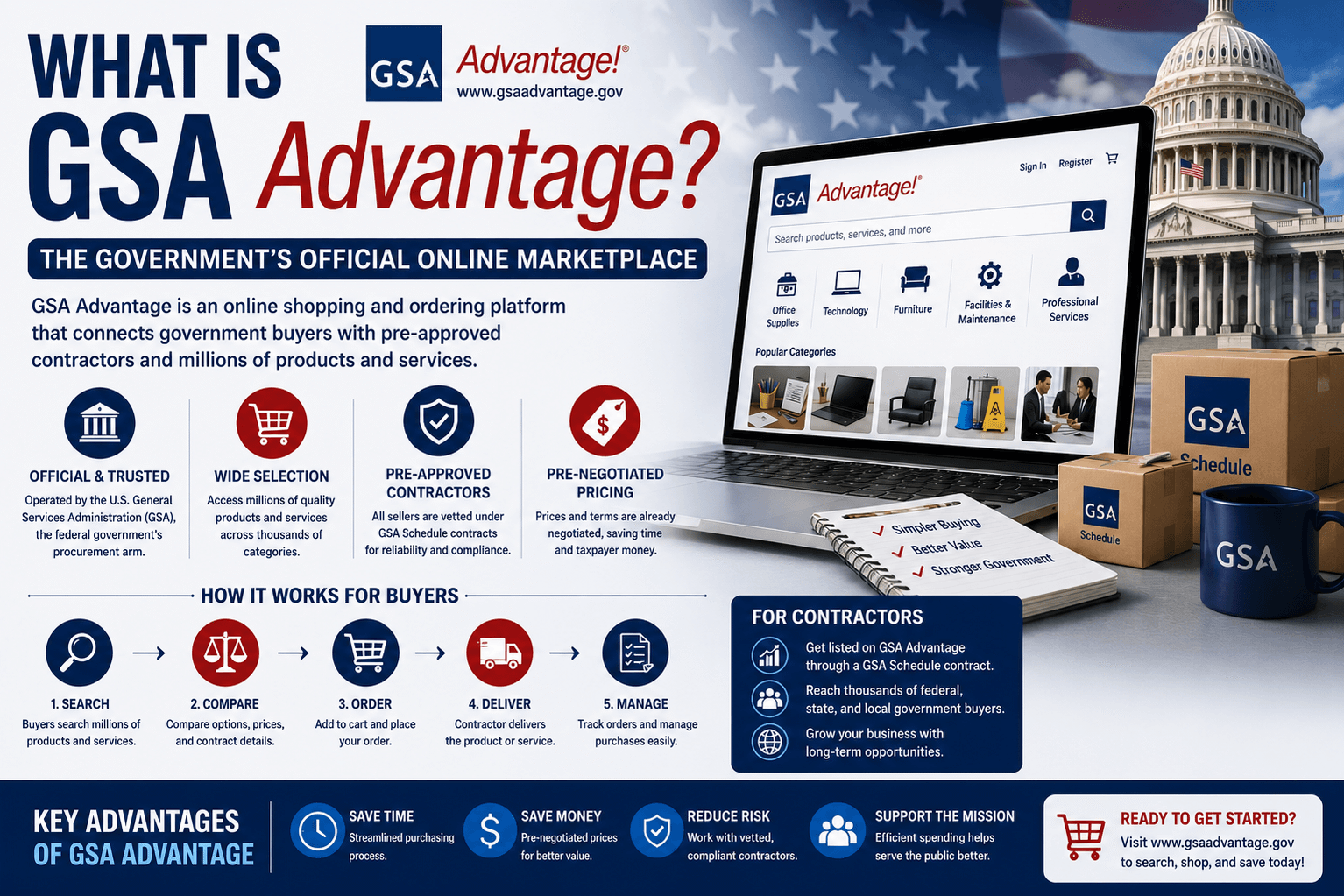
GSA Advantage is the federal government’s official online marketplace for buying products and services from pre-approved contractors. Authorized government buyers use the platform to compare vendors and place orders at prices the government has already negotiated. As a result, agencies skip the slow open market procurement process for routine purchases.
The U.S. federal government spends over $700 billion every year on products and services. A large share of that purchasing runs through this single platform. For contractors, getting listed opens direct access to thousands of government buyers across every agency in the country.
This guide explains what GSA Advantage is, what the GSA does, what agencies can buy, who is authorized to purchase, how ordering works, and how contractors get listed.
What Is GSA Advantage?
GSA Advantage is an online purchasing marketplace operated by the U.S. General Services Administration. The platform lets authorized government buyers browse, compare, and purchase products and services from vetted contractors. Every price and contract term is settled in advance under the GSA Schedule program, which makes the platform faster than standard federal acquisition.
So what does GSA stand for? GSA stands for General Services Administration, the federal agency that acts as the central buying office for the U.S. government. The GSA manages federal buildings, negotiates contracts with commercial vendors, and runs the purchasing and technology systems agencies depend on every day. It operates the marketplace through its Federal Acquisition Service (FAS), which also manages the GSA Schedule Program.
That program connects agencies with contractors through pre-negotiated Multiple Award Schedule (MAS) contracts. Each contractor’s products and services sit under Special Item Numbers (SINs). These SINs define exactly what a contractor holds approval to sell. Therefore, a contractor can only offer items that fall within the SINs awarded under their contract.
Many people call the platform Amazon for government procurement, and the comparison fits. Buyers search by product, compare vendors, review pricing, check delivery terms, and place orders in a single session. The key difference is trust. Every seller has already cleared a federal contracting process, and the government has already approved every price as fair and reasonable.
GSA Advantage vs. GSA eBuy: What Is the Difference?
GSA Advantage handles catalog-based purchasing, while GSA eBuy handles larger and more complex requirements through competitive quotes. On eBuy, agencies post Requests for Quotes (RFQs), and contractors under GSA Schedule contracts submit proposals. eBuy is the right channel for customized work, higher value services, or requirements beyond a standard catalog order.
Government buyers also use the catalog platform for market research before issuing a formal solicitation. Agencies review contractor capabilities, compare pricing structures, and identify qualified vendors before deciding how to structure a procurement.
What Can Agencies Buy on GSA Advantage?
Agencies can buy nearly every category of product and service on GSA Advantage, from office supplies and IT hardware to professional consulting services. The platform organizes purchasing into major categories such as building and industrial supplies, electronics and technology, law enforcement and security equipment, janitorial products, office equipment, scientific and medical supplies, furniture, vehicles, and professional services.
Within those categories, agencies purchase a wide range of items. For example, IT hardware, cybersecurity solutions, laboratory equipment, medical supplies, flooring materials, industrial tools, telecommunications systems, and food service equipment are all available through approved GSA Schedule contracts. The platform also supports specialized services such as consulting, project management, engineering support, and technical solutions.
Beyond standard purchasing, the platform supports several special programs. GSA Global Supply helps agencies buy everyday operational items, including office supplies and maintenance equipment. The Disaster Recovery Purchasing program lets state and local governments buy emergency preparedness and disaster recovery supplies from approved vendors. Agencies can also use the Contractor Information Tools to review award details, pricing catalogs, and service files for complex procurements.
Buyers frequently use the marketplace for purchases under the micro-purchase threshold, which is generally $15,000 for most federal purchases under FAR 2.101 at Acquisition.gov. Some categories carry lower limits. Construction subject to the Davis-Bacon Act carries a $2,000 threshold, and certain service contracts set the limit at $2,500. Emergency situations permit higher thresholds depending on the acquisition type.
Who Can Buy Through GSA Advantage?
Only authorized government buyers with approved credentials can place orders on GSA Advantage. Anyone from the public can browse the marketplace, but the checkout system requires government purchase cards and agency billing codes. Personal purchases are never permitted.
Federal agencies across all three branches of government hold purchasing authority on the platform. This includes executive branch departments, legislative branch organizations, judicial branch entities, government-owned corporations, and federal contracting offices. Agencies such as the Department of Defense, the Central Intelligence Agency, and the U.S. Postal Service all use the marketplace for routine purchasing.
State and local governments can also buy through specific programs. The Cooperative Purchasing Program gives eligible state and local governments access to information technology, cybersecurity, security systems, and law enforcement equipment from Schedule contractors. Similarly, the Disaster Recovery Purchasing Program extends access to emergency supplies during major disaster events.
Authorized tribal governments and tribal organizations can purchase for mission-related needs. This includes organizations operating under the Indian Self-Determination and Education Assistance Act (ISDEAA) and the Native American Housing Assistance and Self-Determination Act (NAHASDA). Eligible educational institutions, including public school systems, community colleges, and approved universities, also hold purchasing authority under designated programs. Certain nonprofits involved in emergency response, including the American Red Cross, are authorized buyers as well.
Other authorized entities include the District of Columbia government, U.S. territories such as Puerto Rico, Guam, and the U.S. Virgin Islands, mixed-ownership government corporations, and certain federal contractors operating under approved contracts. All purchases must run through official government payment methods, and GSA SmartPay cards are the most common instrument.
How Does Ordering Work on GSA Advantage?
Ordering on GSA Advantage follows four steps: log in with approved government credentials, search and compare products, check out with an official payment method, and track the order through delivery. The process feels like standard e-commerce, but the system restricts it to verified government buyers and builds it around federal acquisition rules.
Step 1. Register and Log In
Eligible users log in with approved platform credentials. Accounts typically link to a Government Purchase Card (GPC), an Activity Address Code (AAC), or a Department of Defense Activity Address Code (DoDAAC). These identifiers connect every order to the correct agency billing and procurement tracking systems.
Step 2. Search and Compare
Buyers search the marketplace using keywords, product names, manufacturer details, National Stock Numbers (NSNs), contractor names, or product categories. Search results display pricing, features, delivery timelines, warranty terms, and contractor information side by side. Buyers can add items to a digital cart, save carts for later, or share carts with team members for internal review before checkout.
Step 3. Check Out and Pay
The buyer finalizes the order and pays through a Government Purchase Card, a direct agency billing system, or an AAC or DoDAAC payment method. Once payment is authorized, the system generates a purchase order and sends it directly to the selected contractor.
Step 4. Receive and Track the Order
The contractor receives the order through the GSA Purchase Order Portal and must officially accept it before processing begins. After acceptance, the contractor ships the order and uploads tracking information into the system. The buyer monitors status through the platform, and the order closes once delivery meets contract terms.
How Do Agencies Order Services?
Service procurement works differently from product purchasing. Agencies commonly use the catalog to research service providers, compare contractor capabilities, and review pricing before making a decision. For larger or specialized service requirements, agencies contact contractors directly, request quotes, or route the requirement through GSA eBuy rather than checking out online.
How Do Contractors Get Listed on GSA Advantage?
Contractors get listed on GSA Advantage by winning a GSA Schedule contract, most commonly through the Multiple Award Schedule (MAS) program, then publishing an approved catalog. Businesses cannot simply sign up like they would on a commercial marketplace. The full process from application to active listing typically takes 6 to 12 months, depending on business readiness, documentation quality, and negotiation timelines.
Phase 1: Obtain a GSA Schedule Contract
The first step is registering at SAM.gov to receive a Unique Entity Identifier (UEI). During registration, the business selects the NAICS codes that define its industry and service categories. Without an active SAM.gov registration, a business cannot participate in any federal contracting program, including GSA Schedules.
Next, the business submits a proposal through the GSA eOffer system. That proposal includes past performance records, financial documentation, technical capability statements, and a detailed pricing list. A GSA Contracting Officer then reviews the proposal and negotiates pricing to confirm it meets fair and reasonable standards. This step is mandatory, because GSA will not award a contract without completed pricing negotiations.
Once negotiations close and the proposal wins approval, the contractor receives a GSA Schedule contract number. That number unlocks access to GSA procurement systems, including the storefront.
Phase 2: Upload and Publish the Catalog
After the contract award, the contractor must publish a product or service catalog within 30 days. Missing this window delays market entry and may require extra coordination with the GSA Vendor Support Center. The contractor first registers the awarded contract with the Vendor Support Center, which manages onboarding and catalog activation.
Catalog uploads go through the FAS Catalog Platform (FCP), the mandatory system for new contractors. A legacy system called the Schedule Input Program (SIP) remains available in limited cases for existing contractors.
Each catalog entry must include a product description between 10 and 1,000 characters, at least one high-quality product image under 1 MB, pricing that includes the Industrial Funding Fee (IFF), and detailed delivery terms. The IFF is currently 0.75% and covers the contractor’s share of GSA contract administration costs. All submitted prices must include this fee. A Contracting Officer reviews the uploaded catalog for compliance, and approved listings publish automatically to the storefront.
How Do Contractors Stay Active After Approval?
Contractors stay active by keeping listings compliant, reporting sales, paying the Industrial Funding Fee, and completing periodic contract renewals. Getting listed is not the finish line, because GSA enforces ongoing standards on every active contract.
Every listing must clearly identify the manufacturer name, part number, and country of origin. Product descriptions must stay factual and free from promotional language. Each item needs at least one high-quality image, and pricing must remain transparent with clearly defined delivery terms.
Beyond catalog management, contractors must submit regular sales reports to GSA, pay the IFF on all platform sales, file contract modifications whenever pricing or catalog details change, and renew the contract on schedule. Failing to meet these requirements can trigger contract termination and removal from the marketplace.
Once approved and active, GSA Advantage gives contractors direct access to one of the largest and most stable purchasing marketplaces in the U.S. federal system. Buyers across thousands of agencies can find, compare, and order from an approved contractor’s storefront without any extra procurement steps. For businesses starting the process, the first concrete action is completing SAM.gov registration, which takes about two weeks and costs nothing.