
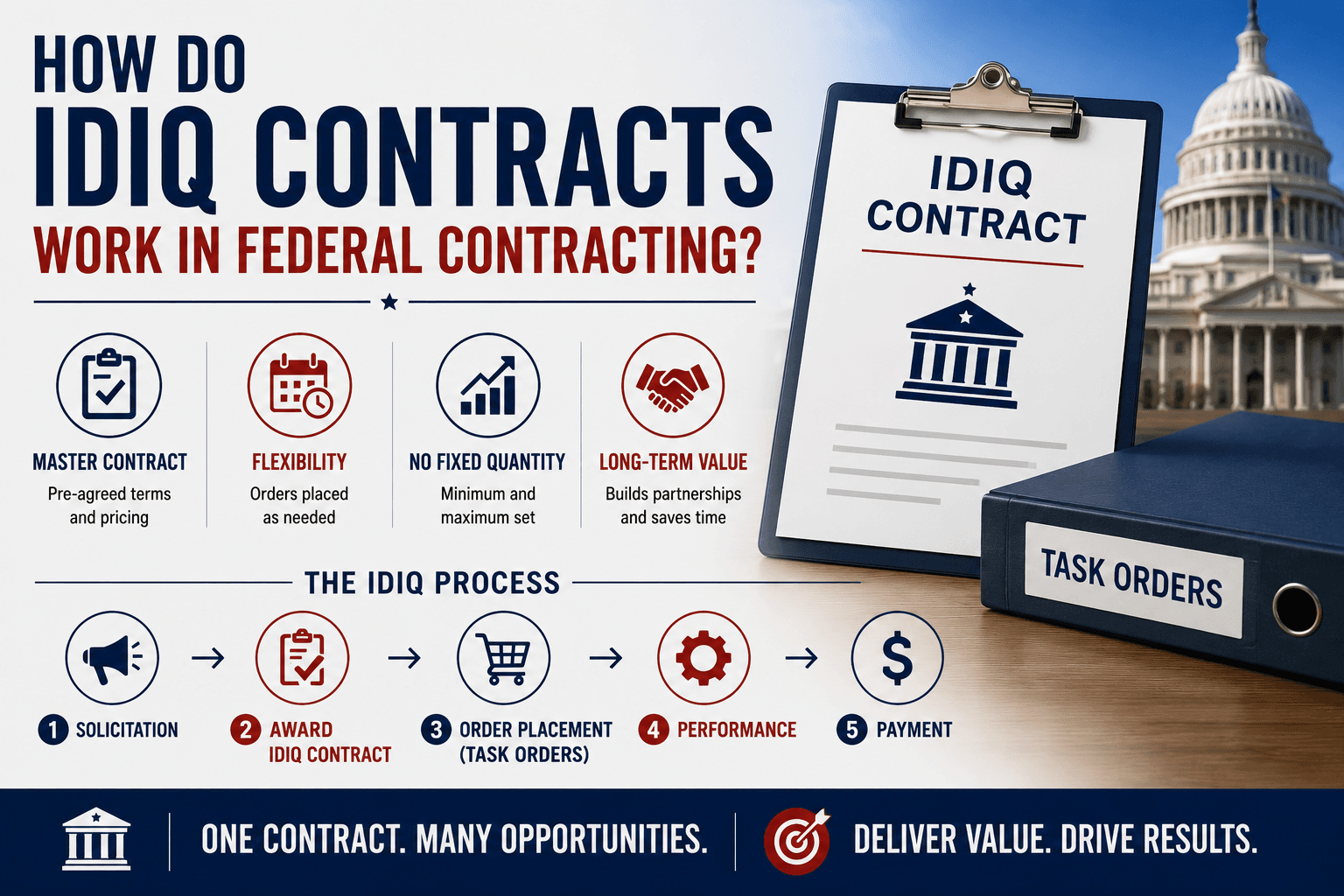
An IDIQ contract is a master contract for buying goods or services over time. IDIQ stands for Indefinite Delivery, Indefinite Quantity. The agency does not say up front how much it will buy or when. Winning one does not hand you money. It puts you on the list, and the work arrives later as separate orders.
Every IDIQ sets two numbers. The minimum is the small amount the agency must buy from you. The ceiling is the most it is allowed to buy. Your job after award is to keep winning orders between those two numbers.
What Is an IDIQ Contract in Federal Contracting?
An IDIQ contract is an agreement to supply an unknown quantity of goods or services during a set period. FAR Subpart 16.5 holds the rules. Agencies use this type when they know what they will need but cannot say how much or when. The contract fixes the terms, the prices, and the ordering rules. The actual work comes later through task orders and delivery orders.
Agencies like this setup for three reasons. They can buy fast, because the hard part of the competition is already done. They can change direction when budgets shift. And they only deal with companies that already passed a review, so their risk is lower.
The trade for you is simple. You spend real money bidding for a seat, and the seat pays nothing on its own. Contractors who treat award day as the finish line usually collect only the minimum.
How Does the IDIQ Contract Process Work?
The process runs in two phases. First the agency picks who is allowed to sell. Then it buys, one order at a time.
Phase 1: How Do You Get on an IDIQ Contract?
- The agency posts the solicitation. It lists the work, the ordering rules, the ceiling, and the guaranteed minimum. You send a proposal with your experience, your technical approach, your past performance, and your prices.
- The agency picks the winners. It may choose one company or many. Winning means you are now allowed to compete for future work, nothing more.
- You sign the master contract. This locks in the terms, the labor rates, and the steps the agency will follow every time it places an order.
Phase 2: How Does an Agency Order the Work?
- The agency writes an order when a real need shows up. Services go out as task orders. Products go out as delivery orders.
- The order gets competed or handed out, depending on how many companies hold the contract.
- The winner performs. You do the work or ship the goods under the terms already set in the master contract.
- The contract closes once all orders are finished and the paperwork is settled.
What Is the Difference Between a Single-Award and a Multiple-Award IDIQ?
The difference is how many companies hold the contract, and that changes how you get work. Under a single-award IDIQ, one company holds it and orders come straight to that company. Under a multiple-award IDIQ, several companies hold it and they compete for each order.
| Question | Single-Award IDIQ | Multiple-Award IDIQ |
|---|---|---|
| Who holds it | One company | Several companies |
| How you get work | Orders come straight to you | You compete against the other holders |
| Your win rate | High, but the agency may order little | Lower per order, but the pot is bigger |
| Speed for the agency | Fastest, no order competition | Slower, but usually cheaper |
| How common | Less common | The normal choice under FAR 16.504(c) |
Multiple-award is the normal choice. FAR 16.504(c) tells contracting officers to prefer it when they can, because competition at the order level keeps prices down. So plan for a seat that gives you the right to bid, not a seat that feeds you work.
What Is Fair Opportunity Under FAR 16.505?
Fair opportunity means every company on a multiple-award IDIQ gets a real chance to bid on each order. FAR 16.505 requires the agency to send clear notice of what it wants, explain how it will choose, and give every holder a fair look. The rule covers orders above the micro-purchase level.
The rule has five main exceptions. An agency can skip the competition when:
- The need is urgent and a delay would cause real harm
- Only one holder can do the work
- The order follows on from an order that was already competed
- The order is needed to meet your guaranteed minimum
- A law requires a specific source
Single-award IDIQs sit outside this rule. There is nobody else to compete with.
Two things protect you if an order looks unfair. First, every agency must name a task order ombudsman under FAR 16.505(b)(8). That person reviews complaints about fair opportunity. Second, you can protest, but only in narrow cases.
You may protest when the order goes beyond the scope, period, or ceiling of the master contract. You may also protest any order worth more than $10 million. That figure rises to $25 million for Defense, NASA, and Coast Guard contracts. All of these protests go to the Government Accountability Office.
What Are the Key Parts of an IDIQ Contract?
Five parts control how much work you can actually get. Read them in the solicitation before you decide to bid.
| Part of the Contract | What It Means for You |
|---|---|
| Ceiling | The most the agency can order in total. It is a limit, not a promise, and most vehicles never spend it all. |
| Minimum guarantee | The smallest amount the agency must buy. It is often small, but the government must set money aside for it at award. |
| Maximum order limit | The biggest single order you must accept. You can turn down anything larger, if you send written notice in time. |
| Ordering period | The window when orders can be placed. Most run a base period plus option years. |
| Task order | An order for services, such as engineering support or help desk work. |
| Delivery order | An order for products, such as laptops or spare parts. |
The maximum order limit is the part contractors misread most often. It is not the ceiling. It is the size of a single order you must accept, and FAR 52.216-19 lets you refuse anything bigger. You just have to return the order in writing within the days your contract allows.
What Are the Biggest Federal IDIQ Contract Vehicles?
The biggest ones are government-wide acquisition contracts, known as GWACs. A GWAC is an IDIQ that any federal agency can order from, not just the agency that set it up. Every GWAC is an IDIQ, but most IDIQs are not GWACs, because only a few contracts get that government-wide status.
Three examples show the range. OASIS+ is a General Services Administration vehicle for professional services such as management, technical, and engineering support. NASA SEWP is used across the government for IT products and hardware. GSA Alliant supports large IT services work. The National Institutes of Health also runs the CIO-SP family for health IT and technical services.
Check the status before you plan around any of them. These vehicles run in generations, and agencies replace them every few years. A vehicle that is closed today may open a new round later. That new round is called an on-ramp.
Where Do Agencies Use IDIQ Contracts Most?
Agencies use IDIQ contracts wherever the need repeats but the timing is unclear. Six areas cover most of the spending:
- IT work, including software, cybersecurity, cloud, networks, and help desk support
- Professional services, such as consulting, program management, financial support, and training
- Engineering and construction, including design, repair, renovation, and infrastructure projects
- Logistics, such as transport, warehousing, and inventory management
- Facility upkeep, including maintenance, repairs, and building services
- Research and technical support, such as testing, lab work, and analysis
How Do You Win Task Orders After Winning an IDIQ Contract?
You win orders by being ready before the order appears. A fair opportunity notice often gives you two or three weeks. That is not enough time to build a team from scratch.
- Track the vehicle daily. Orders are posted to the holders, not to the public, so assign one person to check the portal and the email box every day.
- Line up your team early. Sign teaming agreements with the partners who fill your gaps before a notice drops, not after.
- Keep your labor categories and rates current. Most orders are priced against the rates already in your master contract, so stale rates lose on price.
- Bid the orders you can win. Holders who chase everything burn out their proposal staff and score poorly. Pick the orders that match your past performance.
- Protect your performance record. Order-level ratings follow you into every future evaluation, and a weak rating costs you the next order.
Common Questions About IDIQ Contracts in Federal Contracting
What is the difference between an IDIQ and a BPA?
An IDIQ is a contract with a guaranteed minimum and a ceiling, and the work comes through task or delivery orders. A blanket purchase agreement, or BPA, is a simpler arrangement for repeat buying. It usually promises nothing, and each call is a fresh purchase rather than an order under a contract.
What happens if the agency only buys the minimum?
The agency has met its legal duty and owes you nothing more. That is why the minimum matters when you decide whether to bid. Ask how much the agency really spent on the last version of the vehicle. Past spending is a far better guide than the ceiling.
Can a small business win an IDIQ contract?
Yes. Agencies set aside many IDIQ vehicles for small businesses. Larger vehicles often hold separate small business pools. Some contracts also open on-ramps that let new companies join after the first awards, so watch a closed vehicle instead of writing it off.