
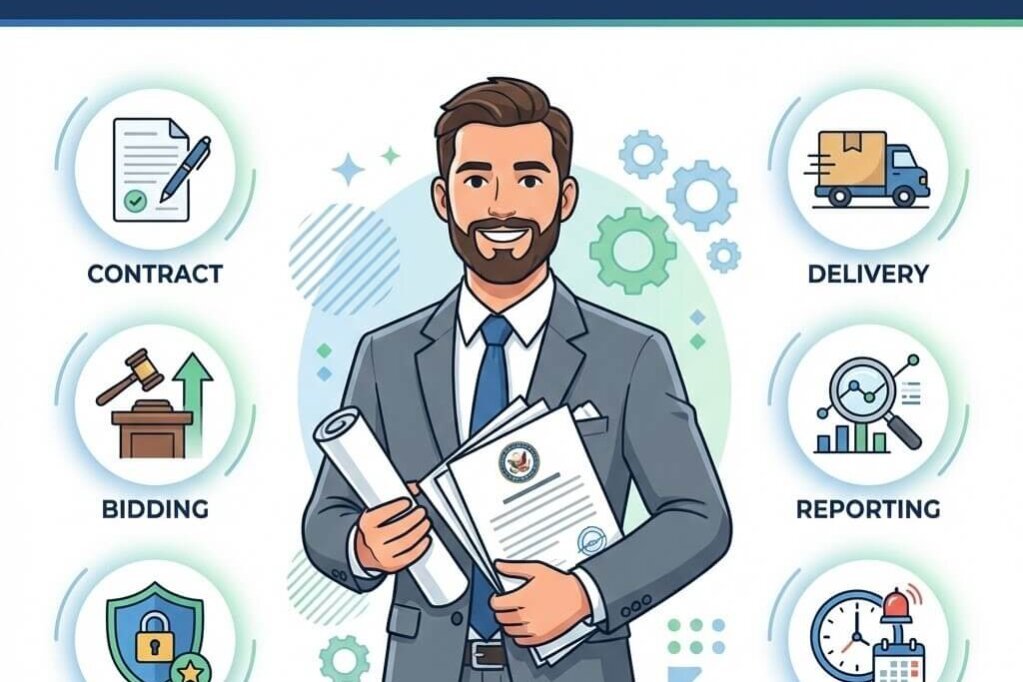
Want to know about government contracting? What are they and what they actually do ? You are at the right place.
Many people think government contracting means just selling things to the government. But it is actually much more complicated than that. When you work with the government, you must follow special rules and laws that are very different from regular business. Companies that don’t understand these differences often run into problems. They might miss deadlines, break rules by accident, or lose money.
In this article we will help you to understand what a government contractor is and what they actually do. We will explain the jobs and responsibilities that contractors take on when they work with the government.
Everything we explain in this article comes from the real rules that all U.S. government agencies use and our experience in government contracting . These are the same rules whether you work with a small city office or a big national agency.
What Is a Government Contractor
A government contractor is a private business or individual that provides goods or services to federal, state, or local government agencies under a legally binding contract. These contractors are independent entities. They are not government employees. They compete for work by formal procurement processes and must meet strict contractual and regulatory requirements.
Key Responsibilities of Government Contractors
Deliver the Work Exactly as Required
Every contract tells you exactly what to deliver. For example, if it says you need to provide 500 items that meet certain quality standards by a specific date, you must do exactly that. You cannot deliver different items, change the amount, or deliver late without getting official permission first.
The government will not accept informal changes or spoken agreements. Everything must be written down and approved properly through a modification, which is an official document that changes the original agreement.
Follow Compliance and Regulatory Requirements
Gov’t Contractors must follow many different rules and regulations. If you work with the national government, you follow something called the Federal Acquisition Regulation (FAR). If you work on defense or military projects, you follow additional rules called DFARS. State and local governments have their own sets of rules that you must follow.
Depending on what type of work you do, you might need special certifications or licenses. You may need to follow specific labor laws about how you pay workers. You might need to meet cybersecurity rules to protect computer systems and data. You may need certain types of insurance coverage. Some work requires security clearances for you and your employees. You must follow all these rules for the entire time of your agreement, not just when you first get it.
Maintain Documentation and Reporting
Working with the government requires keeping detailed records of everything you do. You need to track how many hours your workers spend on the project, what materials you use, how much everything costs, and any other companies you hire to help you. Many agreements require you to send regular reports about your progress, your finances, and your compliance with the rules. The government can check all your records at any time to make sure you are doing everything correctly.
Manage Billing and Payment Procedures
Getting paid requires following strict rules. You must submit your invoices, which are your bills, through specific computer systems that the government uses. Your invoices must include certain certifications and follow exact formats. If your invoice is wrong or missing information, it will be rejected and you will not get paid until you fix it. Payment can take time even when everything is correct. It is common to wait 30 days or longer to receive payment, and different types of agreements have different payment timelines.
Communicate With Government Agencies and Partners
You must report problems as soon as they happen. If you do not understand something in your agreement, you should ask questions right away. You need to keep informed the contracting officer, who is the government person managing your work about how things are going and any risks or challenges you face. If you are working as a subcontractor, which means another company hired you to help with their work, you must also communicate clearly with that main contractor.
Types of Government Contractors
Government contractors operate in different roles depending on the agency, contract level, and scope of work. Many businesses move through multiple roles as they gain experience.
Federal Contractors
Federal contractors work directly with U.S. federal agencies. These agencies include civilian departments and defense-related organizations. Federal contracting represents the largest share of government procurement spending and covers a wide range of industries and services.
Federal contractors must register in the System for Award Management (SAM.gov) and comply with federal acquisition regulations. Competition often includes firms from across the country and, in some cases, international vendors.
State Contractors
State contractors provide goods and services to state-level agencies such as departments of transportation, education, health services, and environmental protection. Each state operates its own procurement system with unique rules, though many principles are similar to federal contracting.
State contracts range from small service agreements to large infrastructure and public works projects.
Local Contractors
Local contractors serve cities, counties, municipalities, school districts, and other local government entities. These contracts are often smaller and regionally focused, making them a common entry point for small businesses new to government contracting. Procurement processes at the local level are typically less complex than federal contracting.
Prime Contractors
A prime contractor holds the primary contract directly with the government agency. The prime contractor is fully responsible for contract performance, compliance, reporting, and managing any subcontractors involved in the work.
Subcontractors
Subcontractors support prime contractors by providing specialized services or products. Subcontractors do not have a direct contractual relationship with the government agency, but they must still comply with applicable contract clauses and performance requirements.
How Government Contracts Work
Government agencies publicly announce contract opportunities through official procurement platforms such as SAM.gov for federal contracts or state and local procurement portals.
Once an opportunity is identified, interested contractors submit proposals that respond to the solicitation requirements. Proposals typically include a technical approach, past performance information, pricing, and required certifications.
Agencies evaluate proposals using stated evaluation criteria. Awards are generally based on best value, which considers technical capability, past performance, and price. The lowest price does not always win.
After award, contractors perform the work according to contract terms. This includes delivering goods or services, meeting milestones, submitting required reports, and maintaining communication with the contracting officer or project manager.
Invoices are submitted as work is completed and accepted. Once all contract obligations are fulfilled, the contract enters a closeout phase where final documentation is submitted and payments are reconciled.
Types of Government Contracts
Fixed-Price Contracts
Fixed-price contracts establish a set price for defined work. These contracts are common when requirements are clear and costs can be accurately estimated. The contractor assumes the risk of cost overruns but retains any cost savings.
Cost-Reimbursement Contracts
Cost-reimbursement contracts pay allowable costs up to an agreed ceiling, plus a negotiated fee. These contracts are used when work scope or costs cannot be precisely defined in advance. Financial risk is shared, with greater oversight from the government.
Time and Materials Contracts
Time and materials contracts pay fixed labor rates and the cost of materials up to a contract ceiling. These contracts provide flexibility when exact scope or duration is uncertain but require careful cost monitoring.
Indefinite Delivery Indefinite Quantity (IDIQ) Contracts
IDIQ contracts establish terms and pricing for future orders without committing to specific quantities upfront. Agencies issue task or delivery orders as needs arise during the contract period.
Blanket Purchase Agreements (BPAs)
BPAs simplify recurring purchases by establishing pre-approved pricing and ordering procedures. They are commonly used for commercial products and routine services.
GSA Schedule Contracts
GSA Schedule contracts are long-term agreements with the General Services Administration that allow federal agencies to purchase from pre-negotiated vendors without conducting separate full competitions.
Benefits of Being a Government Contractor
Government contracting offers meaningful advantages, but it also requires long-term commitment and operational discipline.
Stable, Long-Term Revenue
Many government contracts span multiple years and include option periods. This provides revenue predictability that supports hiring, planning, and investment decisions.
Large Market Opportunities
Federal, state, and local governments collectively spend hundreds of billions of dollars each year. Opportunities exist across nearly every industry, from construction and IT to professional services and manufacturing.
Repeat Work and Past Performance Value
Agencies prefer contractors with proven performance. Strong past performance increases competitiveness for future awards and follow-on contracts.
Business Credibility
Successfully performing government contracts demonstrates an ability to meet rigorous standards and manage complex compliance requirements. This can strengthen a company’s reputation in both public and private markets.
Small Business Set-Aside Programs
Government programs reserve a significant portion of contracts for small businesses, including those owned by women, veterans, and businesses operating in underserved areas.
Growth From Subcontractor to Prime
Many firms begin as subcontractors and gradually build the experience needed to compete as prime contractors.
How We Supports Government Contractors
Govcon Digest supports businesses at various stages of their government contracting journey, from early exploration to active contract performance.
We assist with System for Award Management (SAM) registration and maintenance to ensure businesses meet eligibility requirements for federal contracting. This includes managing technical registration details and renewal timelines.
For bidding and proposal preparation, we provide compliance reviews to help identify missing requirements, documentation gaps, and submission risks before proposals are submitted.
We also support proposal development by assisting with pricing structures, required forms, and submission procedures aligned with government solicitation standards.
After contract award, we offer support related to compliance obligations, reporting requirements, and contract administration challenges. Government contracts impose ongoing responsibilities, and proper management is essential throughout the contract lifecycle.