

SBA Cracks Down on 8(a) Contracting Integrity!

In a bold move to restore trust and transparency in small business federal contracting, the Small Business Administration (SBA) has launched an in-depth audit of its 8(a) contracting program. This sweeping review will focus on contracts labeled as “high-dollar and limited competition” and spans the past 15 years, signaling a major shift in how the SBA is approaching oversight and accountability.
The audit announcement follows a major corruption case revealed in early June, in which a former U.S. Agency for International Development (USAID) contracting officer pleaded guilty to participating in a decades-long bribery scheme. Alongside this plea, three industry executives also admitted guilt, and two companies acknowledged their involvement, shaking confidence across the contracting community.
Actually SBA Administrator Kelly Loeffler didn’t hold back, stating in a press release: “We must hold both contracting officers and 8(a) participants accountable and start rewarding merit instead of those who game the system.” It’s a clear message to all stakeholders , the days of looking the other way are over. Yes, very straightforward! The audit will be led by the SBA’s Office of General Contracting and Business Development and its findings will be forwarded to the Office of Inspector General (OIG) and the Department of Justice (DOJ) for further action. This isn’t just paperwork; it’s a high-level investigation with potential implications for past and current contractors.
What does this mean for small businesses? If you’re an 8(a) participant or working as a subcontractor or teaming partner with one , now is the time to review your compliance records, double-check your eligibility documentation, and make sure your contracting practices are airtight. For non-8(a) GovCons, this is still a critical reminder that ethical contracting and transparent recordkeeping are essential, especially when competing for set-aside work. So, Get up and take tips for the next move!
📜 COMPLIANCE AND REGULATION UPDATES

The FAR Council’s latest regulation update revises Part 6, streamlining competition requirements and relocating small business set-aside provisions to the forthcoming FAR Part 19. This regulation overhaul ensures Contracting Officers retain authority to designate set-asides for small businesses, though the “Rule of Two” is no longer specified in Part 6.
The regulation strategy focuses on consolidation, aiming to simplify future regulation updates for both practitioners and the FAR Council. Currently, statutory set-asides apply only to contracts between micro-purchase and simplified acquisition thresholds. For contracts exceeding the simplified acquisition threshold, the Rule of Two remains a regulatory requirement, sparking interest in the upcoming regulation details in Part 19. Contractors must stay proactive, aligning with this regulation framework to ensure compliance as federal regulation standards evolve. This regulation restructuring promotes a clearer, more efficient framework, urging contractors to prepare for Part 19’s release to maintain adherence to federal acquisition regulation requirements.
Sole-Source Procurement Drama
In a recent bid protest at GAO, Assessment and Training Solutions Consulting Corporation (ATSCC) challenged the Navy’s sole-source procurement award to Tactical Electronics for urgent tactical first responder medical training. ATSCC, a Virginia Beach veteran-owned small business, cried foul, claiming the sole-source procurement was unreasonable. But the Navy held firm, justifying the urgent sole-source procurement under FAR 13.106-1(b)(1)(i), citing mission-critical needs and only one viable vendor after market research. ATSCC’s late February 2025 submission didn’t sway the Navy, which prioritized troop safety and deployment timelines. The Government Accountability Office (GAO) reviewed the sole-source procurement and found the Navy’s reasoning solid, denying ATSCC’s protest. This tale underscores the Navy’s discretion in sole-source procurement, ensuring mission readiness.
🔓 Things that can Go Wrong with 8(a) Business Development Program!
In a small town, a young woman named Carla opened a bakery with her grandmother’s recipes and a dream. She joined a program that promised to help small businesses like hers grow. At first, things looked good. She got advice, met mentors, and even landed a government contract. But soon, the cracks begin to show. The support faded, the rules changed, and the help she counted on became harder to reach. Carla’s story is not unique. It mirrors the experience of many who enter the 8(a) Business Development Program with hope, only to face unexpected hurdles.
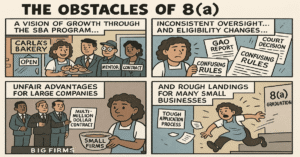
The 8(a) program, run by the U.S. Small Business Administration (SBA), was created to help small businesses owned by socially and economically disadvantaged individuals. It offers training, mentorship, and access to federal contracts. But while the goals are noble, the path is not always smooth.
One major issue is inconsistent oversight. A 2022 report by the Government Accountability Office found that the SBA failed to submit required annual reports to Congress between 2016 and 2021. Without regular reporting, it becomes hard to track whether the program is working or if changes are needed. This lack of transparency can leave participants feeling lost and unsupported.
Another problem is the shifting rules around eligibility. In 2023, a federal court ruling in Ultima Services Corp. v. Department of Agriculture forced the SBA to stop using a long-standing method for determining social disadvantages. Before the ruling, individuals from certain racial and ethnic groups were presumed to be disadvantaged. After the ruling, they had to submit detailed personal narratives to prove it. This sudden change caused confusion and delays. Many businesses had to pause their participation while they gathered new paperwork. As one SBA official told The Washington Post, We understand this is frustrating, but we must follow the court’s order.
The program also struggles with fairness. Some firms, especially those owned by large tribal or native corporations, receive contracts worth millions. Meanwhile, smaller firms often compete for scraps. A 2024 noted that group-owned firms can receive sole-source contracts above the usual limits, giving them an edge over individually owned businesses. This creates a sense of imbalance and raises questions about who the program truly benefits.
Then there is the issue of graduation. The program lasts nine years, after which businesses are expected to stand on their own. But many firms are not ready. They may have relied too heavily on 8(a) contracts and failed to build a diverse customer base. When the support ends, they struggle to survive. A former participant told USA Today, It felt like being pushed off a cliff. One day we had help, the next we were on our own.
Even the application process can be a barrier. It is long, complex, and often requires legal or financial help. For a small business with limited resources, this can be overwhelming. And once accepted, firms must complete annual reviews and stay compliant with strict rules. Any misstep can lead to removal from the program.
Despite these challenges, the 8(a) program remains a valuable tool. It has helped many businesses grow and succeed. But to truly serve its purpose, it needs better oversight, clearer rules, and more support for those who need it most. As SBA Administrator Isabel Guzman said in a 2023 press briefing, “We must ensure that opportunity is not just promised, but delivered.”
Carla’s bakery eventually closed. But her story is a reminder that good intentions are not enough. Programs like 8(a) must be built on trust, fairness, and follow-through. Only then can they truly lift up the businesses they aim to serve.
💰 Lockheed Martin Scores $78M Deal to Power the Navy’s Undersea Combat Edge!

Lockheed Martin is making waves again literally. The defense giant’s Rotary and Mission Systems division just secured a hefty $78.47 million contract modification to further develop and deliver the AN/SQQ-89A(V)15 undersea warfare combat systems , a critical suite of technology that helps U.S. Navy surface ships detect, track, and engage undersea threats.
This award is actually a modification to a previously awarded contract, reflecting the Navy’s confidence in Lockheed’s ability to keep pushing the envelope in sonar and submarine-hunting tech. The scope covers everything from continued development and integration to production, testing, and delivery of spares ensuring that the fleet remains sharp, stealthy, and ready. What’s behind this massive investment? At the heart of it is Hypervisor Technology Zero, a next-gen tech suite designed to give U.S. Navy destroyers and cruisers enhanced situational awareness below the surface. Think of it as the Navy’s underwater brain fusing sensor data, tracking targets, and guiding decision-making in real-time. Work will be spread across several Lockheed locations, with the majority 70% happening in Manassas, Virginia, and the rest split between Pennsylvania, New York, and Florida. The project is funded through a mix of FY25 shipbuilding and procurement funds, all fully obligated at the time of the award and it’s expected to carry through February 2028.What makes this contract especially interesting is its hybrid pricing structure: a mix of cost-plus-incentive-fee, firm-fixed-price, and fixed-price incentive which is firm-target. Means? The Navy is investing with confidence but also ensuring performance and value every step of the way.
For Lockheed Martin, this is a reaffirmation of its central role in the U.S. Navy’s evolving undersea warfare strategy. For the Navy, it’s a step closer to dominating the deep. And for the defense community, it’s a powerful reminder: when it comes to protecting America’s maritime edge, Lockheed is still setting the pace.
📢 Want to be featured in our next issue? [Submit Your Win Here]
🗣️ UPCOMING EVENTS
Event: Impact of the Trump Administration on Government Contracts
Date: Sep 12, 2025
Event: Past Performance: How to Use Yours, Benefit from Others’, and Defend It from Attacks
Date: Oct 28, 2025


